
I wrote the following in spring 1999. The original version of it was used in the June 1999 edition of highly respected football magazine When Saturday Comes. This version contains a couple of corrections.
Scunthorpe United’s top scorer last season, Jamie Forrester, outraged locals by describing the town as “a shed” in a recent interview with top onanist’s periodical Loaded. In the inevitable media storm that followed (well, one publicity seeking local politician blowing a fuse in the town’s nightly excuse for a newspaper) Forrester neatly attempted to sidestep the issue with the same precision he might employ to finish off a move on the pitch. He claimed he’d “never actually used the word ‘shed’”, as if this were crucially distinct from the words he actually uttered. Clever… “All I actually said was that there was nothing to do and nowhere worth going,” he added.
The matter finally whimpered to a halt when United manager Brian Laws went on the local television news to firmly point out that Forrester “was not being derogative”. The confusing intellectual mindgames he was employing seemed to appease the outraged councillor. Forrester’s mildly defiant attitude (“you know what journalists are like”) caused sales of Loaded in Scunthorpe to drop by, ooh, three or four copies a month.
But it is a really offensive indicator of the mercenary attitude of footballers in this day and age when you consider how little respect, and how little real interest, Forrester must have shown in the town when he first signed for the Club. The town may well be considerably less than a hotbed of activity, but Scunthorpe does have redeeming features. If he’d bothered to show an interest and ask, and then had the patience to look, Forrester would have discovered that there are actually myriad modestly stunning locations in the borough – and all of them in some way connected to the history of his employers.
Following redevelopment and the Club’s trend-setting move to a purpose-built stadium on the edge of town, a national chain supermarket now stands on the site of United’s original home. The Old Showground was used by the Club in tandem with local agricultural business to display their bovine stock – some might say that somewhere along the line the two became somehow inexorably mixed up. Those of us old enough to harbour real emotional ties to the gloriously ramshackle but innovative stadium (which boasted the first cantilever stand in Britain, erected in 1958) still find ourselves keenly touched by the hand of history as we pick up our Shredded Wheat.
The kids without Playstations, who gamely fulfil their societal cliches as shoplifting urchins, may well evade the security guards by hopping across the car park wall and running a half mile or so to King Edward Street. It was back here, to his modest Coronation Street-style lodgings, that teenage apprentice Kevin Keegan made it one morning following a bout of extra-curricular laddism with some teammates, during which he crashed and wrote off the Club’s tractor. He didn’t last much longer at United after that and the club offloaded him as soon as some mug came in with an offer.
Just round the corner is Frodingham Road and the house from which Bond / Blofeld actor Donald Pleasance, as a child, would stride purposefully up to The Old Showground to stand on the terraces and, doubtlessly, begin to fully understand the gamut of human emotions and the public impact of arenas of drama.
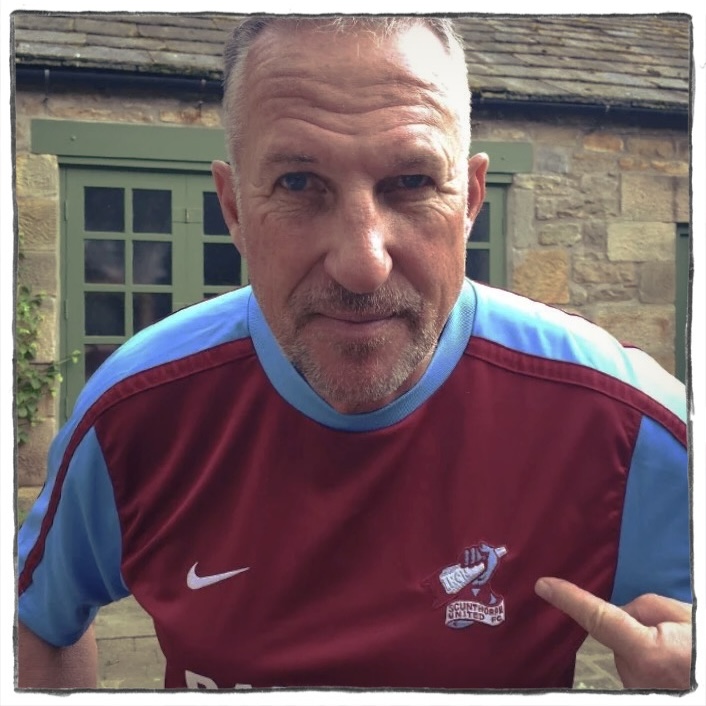
A brick’s throw from Don’s old pad is the seemingly endless boulevard Doncaster Road. Once home to Tiffany’s, a Seventies/Eighties nightclub of the utmost Seventies/Eighties taste, this place features prominently on our tour. It was from this very establishment that goalkeeper Joe Neenan and lan Botham (yes, that one) stepped, minutes before assaulting a local man who had the audacity to question Beefy’s credentials as the libero grande of the team. Botham lasted about six or seven games in a United shirt, was made vice president and then wandered off into the long grass, never to return. He was finally sacked from his honorary position a couple of years ago, after the Club’s officials woke briefly from a perpetual stupor and noticed he’d not even bothered to come and watch a match since his playing days, let alone invest a penny.
The pavement outside what is now an amusement arcade in the town’s shopping centre was itself host to my own first social encounter with a Scunthorpe United player. In the mid-Seventies, when I was six or seven years old, midfielder Mike Czuczman (pronounced something like “Churchman”) was my hero. Due to the complete unavailability of posters of the United team, I’d pinned a picture snipped from the Radio Times to my bedroom wall. I’d appended this small portrait of TV lawyer Petrocelli with the words “Mike Czuczman” carefully spelled out in felt-tip beneath. I was astonished to see Czuczman leaving the High Street dry-cleaners Zerny’s one close season afternoon. Over his arm was a terrible black and grey pinstripe suit.
My Dad raced me over for an autograph, and as Czuczman signed he dropped the hefty piece of gum he’d been chewing onto the ground. I believe the lump is there to this day, though it’s a little greyer. I sometimes pause to look for it, wondering where the years have gone and what happened to Mike. My autographed comic has long since vanished, though I do remember quite clearly that his signature read “Mike Czzzzzzzmzzzzzzn. Skill”. Definitely maybe I added “skill” myself.
The Gunness Straight is a very long road which leads away from Glanford Park, away from Scunthorpe and out into the wilds, beyond which lie Yorkshire and other foreign places. United’s squad are often to be seen engaging in training runs up the Straight, as it’s imaginatively nicknamed. So it was one Monday morning recently as I was driving along it. Curiously, a transit van travelled alongside them for almost the entire length of the road. As I passed it I slowed down to a similar pace and wound down my window to shout some sort of encouragement to the team, only to hear the van-driver get there first.
Undeterred by the squad’s decision to keep their heads down and jog on in ignorance, he was offering all manner of constructive criticism – the kind that might make even beefy Ian Botham blush, before finally giving up and ended his gargantuan tirade with a cursory cry of “Faster, bastards!”. He gave a wheelspin for good measure, showering the team in a tsunami of mud and gravel, and sped off.
He had a Scunthorpe United scarf dangling from his rear-view mirror.
 COUPLEOFKOOKS.COM